Table of Contents
Transregio-SFB 265
Losing and Regaining Control over Drug Intake: From Trajectories to Mechanisms to Interventions
The main risk factors for mortality and morbidity worldwide are alcohol and tobacco consumption. While knowledge about individual factors that influence the initiation and maintenance of substance consums is increasing, there is still a lack of in-depth knowledge about modulatory factors and mechanisms that contribute to the loss and regaining of control over drug use. A better understanding of these factors and mechanisms will be critical to improving the treatment of substance use disorders (SUDs).The goal of our research consortium in TRR265 is to identify the trajectories of loss and regain of control over drug use, to investigate the underlying neurobiological and learning mechanisms, and to develop mechanism-based therapies. These goals should be achieved through 3 approaches: (I) the use of innovative mobile health tools to determine the influence of triggers, (II) in closely networked studies on humans and in animal models, the decisive mechanisms should be identified and mathematically modeled (III) based on this, interventions should be developed that specifically target these mechanisms in order to support regaining control over drug use.
Homepage: https://trr265.org
Important Links
Systems
ORSEE can be accessed via the following links:
link for users
link for admins
1. Access to PAMS
Due to our data protection agreements, there are four separate instances of PAMS with distinct subject pools:
- for the NIC / Psychology: https://nicdb.zih.tu-dresden.de
- for the TRR265: https://pams.zih.tu-dresden.de
- for the TRR393: https://pams-trr393.zih.tu-dresden.de
- for the NEEDS project: https://pams-needs.zih.tu-dresden.de
❗️ Note: PAMS is only accessible from within your institution's network. Mobile work requires the use of a VPN. You might want to check your institution's page in this Wiki for more details.
2. Tutorials and Workshops
- Generate Participant ID
3. How Do I Get Support?
1. Step: FAQs
❔ What can I do if my subject data was not automatically transferred from PAMS to XNAT?
❕ An instruction for manual registration for MRI measurements can be found here.
XNAT can be accessed via the following link:
https://xnat.zih.tu-dresden.de
On this page you will find general information about REDCap.
1. Access to REDCap
Access Link: https://redcap.zih.tu-dresden.de
❗️ Note: The server is accessible over the Internet. VPN access is not required.
❗️ Note: REDCap does not work with some versions of MS Internet Explorer. Please use Firefox, Chrome or Safari.
2. Implementing Tests
Project application
In REDCap, tests are implemented within projects. You can apply for a new project using the project application form.
Sample project
As an introduction to working with REDCap, a sample questionnaire has been created which contains all the important field types and functions:
REDCap sample project live preview
This makes it easier to familiarise yourself with the system and create initial queries. A zip-file of the sample questionaire can be downloaded here. It only needs to be imported in yours REDCap project by clicking on the upload button in the Designer.
Catalog of already available tests
Some of the psychological tests commonly used have already been implemented in REDCap. A list of the implemented tests can be found here:
Catalog of psychological tests.
When a test is selected a preview of the respective questionnaire is shown. The form linked at the end of the overview page can be used to request zip-folders of the desired questionnaires. The file then has to be uploaded in the REDCap project where it is supposed to be used later.
Note: Some fields are not supposed to be visible for the participants during data collection. These fields should additionally be marked with the Action-Tag @HIDDEN-SURVEY.
3. REDCap Tutorials and Workshops
3.1 What is REDCap?
3.2 Registration and Login
3.3 Latest Tutorials
| Updates starting February 2022 | Dispatching Biomaterials |
More specific information about registration and tutorials concerning your institution can be found on the corresponding page:





The Neurological Test Batteries can be accessed via the following links:
Neurotests, Yurys Code
Expfactory, Adaptive N-Back of Jamila
Expfactory, Result Files
Expfactory,Test Library with Demos of the Experiment Factory
Expfactory, Tokens (pw: TRR265_T0ken)
Getting Access Rights for the Systems
1. About this site
In this wiki you will find information about the tools, systems, and procedures used in the CRC projects as well as at the NIC (Neuroimaging Center). Depending on your institution or collaborative research centres you will find useful information on how to access the individual tools, which technical aspects need to be considered, as well as helpful tutorials. We encourage you to keep the articles up-to-date and fix the problems you might find using the edit function. You can also add pages for your studies as you see fit.
This site is open to all persons with a valid login from the TU Dresden or any of the partner institutions participating in the CRC. For this reason, use it at your own discretion and avoid publishing information of a sensitive nature.
2. Information for specific research projects
Some of the information in the wiki is specific to some research projects. You can access that specific information via the links below.
Colaborative Research Centers:
Other projects:
3. Gaining access to the infrastructure
Most of the IT systems can be used with the credentials of your own institution. Two exceptions to this are ORSEE and XNAT.
Please complete the following onboarding form to gain access to the systems:
Members of partner institutions
❗️ If you aren`t a member of TU Dresden, please select your institution at the bottom of this page to get specific information.
4. Information about the Tools available
IT infrastructure
The organization chart shows an overview of our IT infrastructure and the function of the tools and systems included in it.
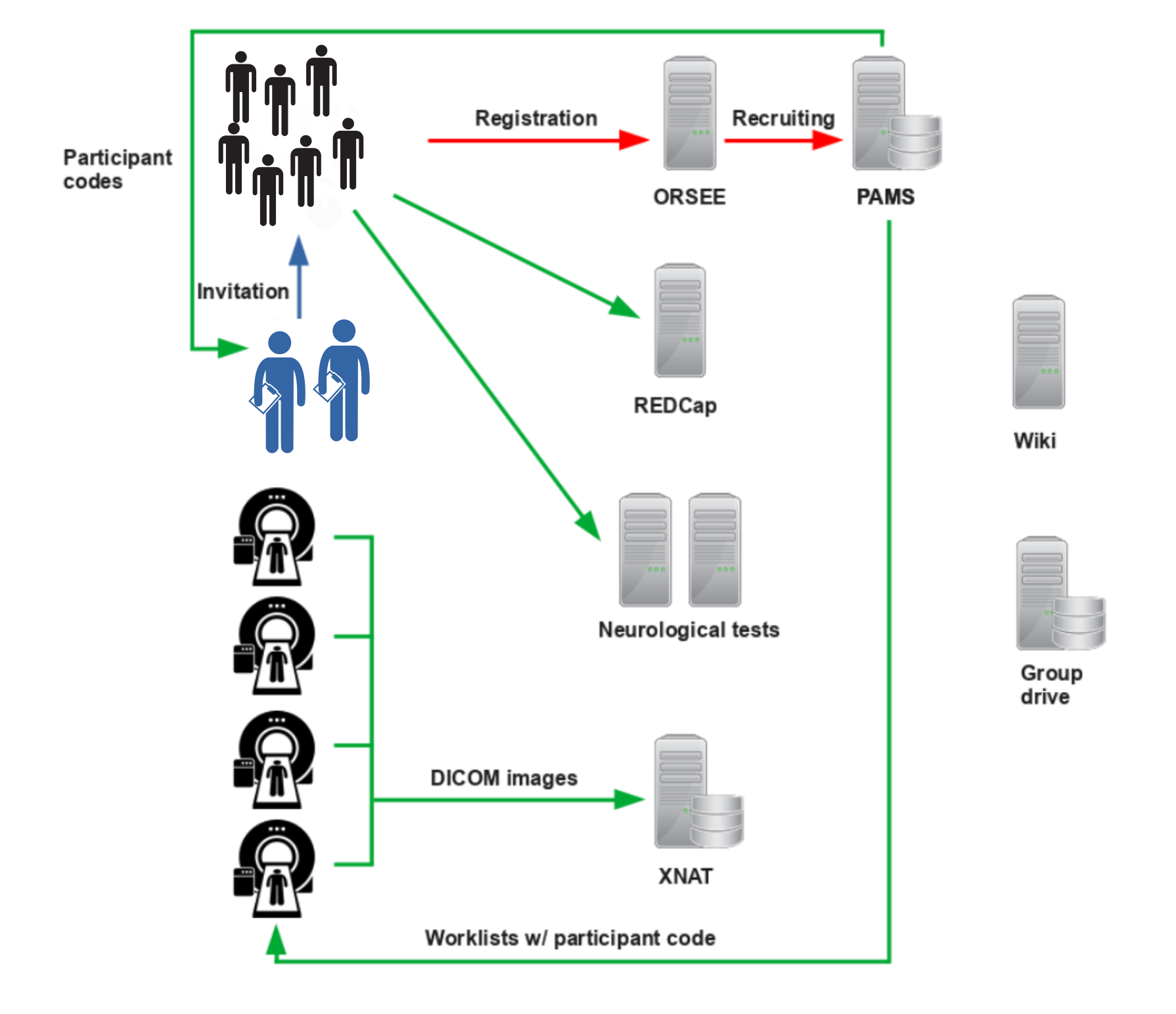
You can find a more detailed explanation about the basic function of all IT tools in this video (originally developed for the SFB):
This section links to more information on specific IT tools as well as to the equipment available at the NIC:







Prisma MRI:
If you used the Prisma MRI machine for your study, please include the following (or a similar) statement in the acknowledgments section of your publications:
“This work was supported by the German Research Foundation (DFG) under grant number INST 269/881-1 FUGG.”
This acknowledges that the upgrade of our MRI machine to Prisma was funded by the DFG.
5. Tutorial Videos about the Tools available
For detailed information about the functions of the tools refer to this video tutorials:
ORSEE-PAMS-XNAT
REDCap
ExpFactory-Neurotests
Participant deletion requests
6. Information for Members of Research Groups and Medical Faculty
7. Information for Members of other Institutions
Specific information concerning your institution can be found here. Please select your organization:
8. Standard operating procedures at the Neuroimaging Center (NIC) at TU Dresden
We are currently in the process to optimise accessibility of the SOPs for the NIC. Currently they are listed on two sites - our group drive (M:\nic\public\) and this neurocloud site: https://neurocloud.zih.tu-dresden.de/index.php/s/AJoKbfps9tPYGxn.
The SOP MRI licence ('MRT-Führerschein') is available here: M:\nic\public\06_SOPs_Scanberechtigung_MRTFuehrerschein
9. Lectures and Meetings
Regular Meetings
We have the following meetings at the NIC TU Dresden
1) NIC-Club full faculty (Jan, Mar, Mai, July, Sep, Nov; first Wednesday of the months at 12.00)
This meeting includes
• Internal talks
• Share our own expertiseon methods-relatedissues
• Presentation of questions/topics identified in the NIC-Club Early Career Meeting (see below)
• External talks (Suggestionsappreciated!)
• Project presentationsformeasurementtime
2) NIC-Club Early Career Researchers meeting (Feb, April, June, Aug, Oct, Dec; first Wednesday of the months at 12.00)
This meeting serves to discuss across lab methods-related questions as well as for identifiying important topics for the NIC-Club full faculty meeting.
Discussion points could for example include:
• You are planning a new study and wonder about pros and cons of alternative designs and measurement/stimulation protocols
• You struggle with the best analysis or experimental strategy
• You experience strange results (likely, others have experienced similar things and might offer solutions or comfort)
• You have data and invented/applied a cool type of analysis you want to share
• You came across a great new methods paper you want to discuss with a larger group
3) NIC-Meeting (usually first Thursday of the months at 14.30)
Discussion between NIC-staff (MTRAs, technicians, MR-physicists) and one member of the NIC-steering committee on day-to-day activities and organisation in the NIC. If you have things to discuss in this meeting, let the NIC-Sekretariat know.
4) NIC-Executive committee meeting
The NIC-Executive committee meets regularly to discuss strategic plans, finances, HR. If you have things do discuss here, please contact one of the executive committee members.
Online lectures on important topics
How Do I Get Support?
If you need support with an issue you may contact us at this mail address:
trr265-inf@groups.tu-dresden.de
NIC secretary:
sekretariat.nic@mailbox.tu-dresden.de
Radiology Technologist:
silke.geissler@tu-dresden.de
ines.wittig@tu-dresden.de
MRI physicist:
difei.wang@tu-dresden.de
Technician:
gernot.pascher@tu-dresden.de
IT:
eckhart.schulz@tu-dresden.de
ORSEE & XNAT & PAMS contact person:
alvaro.aguilera@tu-dresden.de
ORSEE & PAMS:
pams@tu-dresden.de
REDCap contact person:
TRR265 & TRR393 lincoln.sherpa@tu-dresden.de
other projects jens.strehle@tu-dresden.de
❗️ To contact us, please use your official institutional email address.
Guestlogin
TUD-Guestlogin Request
Step 1: Please fill in the following form with the your data for a TUD guest login:
Step 2: When you fill out the form - REDCap sends an email to Jens Strehle (INF Team) and he generates a guestlogin for you.
Step 3: If you have any questions, please send an Email to jens.strehle@tu-dresden.de.
Further Information about Transregio-SFB 265
Standard Operating Procedures
Standard Operating Procedures (SOP): Screenig Procedure
Standard Operating Procedures (SOP): Participant requests data deletion
| Nummer | Kürzel | Name | Standort | Principal Investigators |
|---|---|---|---|---|
| 10101 | S01 | Central recruitment, imaging and biobanking | Mannheim Berlin Dresden | Derik Hermann Henrik Walter Michael Marxen Marcella Rietschel |
| 10102 | S02 | Mobile infrastructure for daily life research | Karlsruhe Heidelberg Mannheim | Ulrich Ebner-Priemer Jan Stallkamp Andreas Meyer-Lindenberg |
| 10103 | INF | Information infrastructure | Dresden | Wolfgang E. Nagel Michael Smolka |
| 10104 | Z | Central Tasks of the Collaborative Research Center | Berlin | Andreas Heinz |
| 10111 | A01 | Longitudinal monitoring of triggers and modifying factors in human addiction | Potsdam Mannheim Berlin | Michael Rapp Tobias Banaschewski Andreas Heinz |
| 10112 | A02 | Longitudinal monitoring of cognitive control as a modifying factor of drinking behavior | Dresden | Lorenz Deserno Michael Smolka |
| 10113 | A03 | Stress-related predictor profiles for craving and relapse in human addiction | Mannheim Heidelberg Dresden | Falk Kiefer Jan Stallkamp Clemens Kirschbaum |
| 10114 | A04 | Intense characterization of triggers, modifying factors and mechanisms at course transition points in human addiction | Mannheim Karlsruhe Berlin | Heike Tost Ulrich Ebner-Priemer Christine Heim |
| 10115 | A05 | Intensive behavioral monitoring and dynamical state transitions in animal models of addiction | Mannheim | Hamid Noori Rainer Spanagel |
| 10116 | A06 | AI-based predictive neuro-behavioral modeling of individual trajectories in addiction | Mannheim | Daniel Durstewitz Georgia Koppe |
| 10117 | A07 | Deep Learning for identifying subtypes in addiction based on structural MRI data | Berlin | Kerstin Ritter |
| 10118 | A08 | Effekte longitudinaler Sexualhormonveränderungen auf Verlust und Wiedererlangen von Kontrolle über den Alkoholkonsum: Prädiktion, Mechanismen und Behandlungstargets. | Berlin | Bernd Lenz |
| 10121 | B01 | Moderators of habitual versus goal-directed decision making in human addiction | Berlin Dresden | Florian Schlagenhauf Tanja Endrass |
| 10122 | B02 | Habit formation and its relevance in alcohol addiction | Mannheim | Anita Hansson Wolfgang Sommer |
| 10123 | B03 | Cue effects in human addiction: Pavlovian to instrumental transfer | Berlin Dresden | Andreas Heinz Maximilian Pilhatsch |
| 10124 | B04 | Cue effects and targeted neuromodulation in animal models and human addiction | Berlin | Christine Winter Josef Priller |
| 10125 | B05 | Cognitive control of negative affect and craving for drug and alternative rewards across substance use disorders | Berlin | Henrik Walter Georg Winterer |
| 10126 | B06 | Probing reward function during the addiction cycle by intracranial self-stimulation: the role of monoamines and alternative rewards | Mannheim | Rainer Spanagel |
| 10127 | B07 | Addiction-related changes in automatic S-R associations and their effects on cognitive control | Dresden | Christian Beste Ann-Kathrin Stock |
| 10128 | B08 | Aversion discounting in behavioral control in animal models and human addiction | Mannheim | Wolfgang Sommer Georgia Koppe Peter Kirsch |
| 10129 | B09 | Computational modelling of impaired control in addiction | Dresden | Michael Smolka Stefan Kiebel |
| 10131 | C01 | Modification of the imbalance between goal-directed and habitual behavior in human addiction | Mannheim | Sabine Vollstädt-Klein Herta Flor |
| 10132 | C02 | Modification of Pavlovian and instrumental learning in human addiction | Berlin | Nina Romanczuk-Seiferth Anne Beck |
| 10133 | C03 | Modification of alternative reward cue reactivity and cognitive control through physical activity in human nicotine use disorder | Berlin | Felix Bermpohl Andreas Ströhle |
| 10134 | C04 | Modification of cue reactivity by neurofeedback and mindfulness-based intervention in human addiction | Mannheim | Peter Kirsch Falk Kiefer |
| 10135 | C05 | Towards causal insights into contextual influences on substance use: Incorporating momentary interventions into everyday life | Berlin Mannheim | Shuyan Liu Markus Reichert |
| 10223 | B03 2. FP | Cue effects in human addiction: Pavlovian to instrumental transfer | Berlin Dresden | Andreas Heinz Maximilian Pilhatsch |
How Do I Get Support?
If you need support with an issue you may contact us at this mail address:
trr265-inf@groups.tu-dresden.de
❗️ To contact us please use your offical institutional email address.